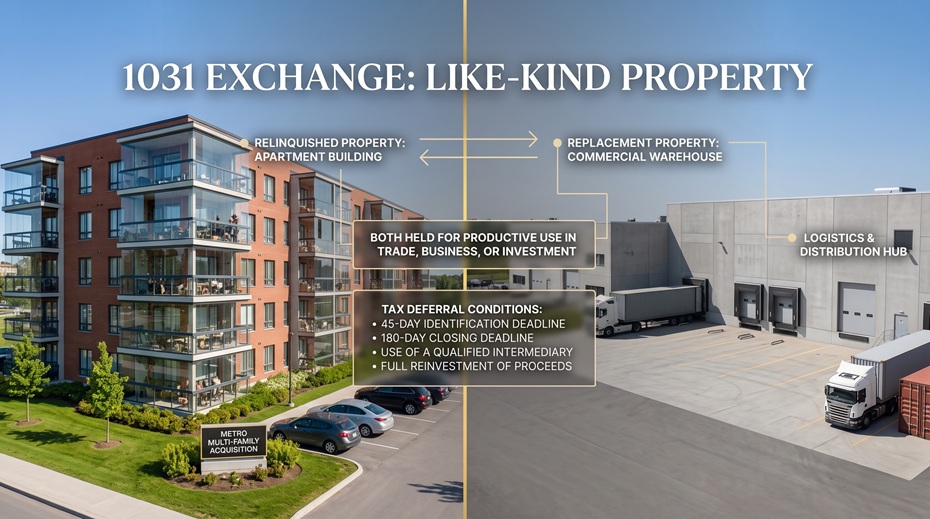
1031 exchanges can defer recognition of gain when qualifying business or investment real estate is exchanged for other qualifying real estate. They do not automatically eliminate tax, and buying another property after a sale is not enough to establish a valid exchange.
If you’re an advisor explaining the strategy, the useful conversation starts with eligibility, timing, control of proceeds, and the client’s reasons for owning the replacement property. A precise explanation can make deferral understandable without turning it into a promise that the client will owe nothing.
Federal tax information checked September 23, 2026.
What Does a 1031 Exchange Actually Defer?
A qualifying exchange postpones recognition of gain to the extent the rules permit. The deferred amount is generally carried into the tax basis of the replacement property rather than erased.
The IRS explanation of like-kind exchanges limits the current provision to qualifying real property held for business or investment. Property held primarily for sale does not qualify. A typical personal residence is not investment or business property simply because its owner expects it to appreciate.
The term like-kind is broader than identical. Qualifying U.S. real estate can often be exchanged across property types; U.S. and foreign real estate are not like-kind to each other. The use and legal character of the assets matter more than whether the buildings look alike.
A useful first sentence is: “This may postpone tax on qualifying gain if the transaction and replacement property meet the exchange rules.” It states the potential benefit and the conditions together.
Why Isn’t Selling and Reinvesting the Same Thing?
In a delayed exchange, receiving or controlling the sale proceeds can defeat the intended treatment. The exchange needs to be arranged so that the taxpayer avoids actual or constructive receipt under the applicable rules.
The IRS guidance on sale proceeds and qualified intermediaries identifies a qualified intermediary as one available safe-harbor route. That intermediary typically helps arrange the exchange and holds proceeds under the exchange agreement. It is not enough to move money out of the seller’s account after closing and call it exchange money.
This is why the conversation belongs before the relinquished property’s closing. Once funds have been received, a later intention to reinvest may not repair the transaction.
An advisor can make this concrete by asking who will receive the proceeds, what the signed agreements permit, and when the intermediary becomes part of the transaction. A vague assurance that someone “handles 1031s” does not answer those questions.
How Do the 45-Day and 180-Day Deadlines Work?
Replacement property generally must be identified within 45 days after transfer of the relinquished property. Receipt must occur by the earlier of 180 days after that transfer or the taxpayer’s return due date, including extensions, for the transfer year.
These periods run from the same transfer date. They do not create 45 days to choose followed by another 180 days to close. The Form 8824 instructions also explain written identification and sufficiently clear property descriptions.
The identification rules limit how many properties or how much aggregate value can be identified, with specific alternatives and exceptions. The intermediary and tax counsel should verify the chosen route. A list of every possible property is not a reliable substitute for compliant identification.
Operationally, the deadline creates a decision constraint. Financing, title questions, inspections, and negotiation still need to be resolved inside it. An advisor should discuss what happens if no acceptable replacement can close, including a partial exchange or a taxable sale where applicable. A deadline should not be described as a reason to ignore a property’s weaknesses.
Can the Client Still Owe Tax After an Exchange?
Yes. Cash or other non-like-kind property received, often called boot, can produce recognized gain. Net debt relief can also affect the calculation.
The result depends on more than the difference between two purchase prices. Liabilities, cash contributed, exchange expenses, adjusted basis, and the character of the assets all need attention. IRS Publication 544 explains exchanges involving money, unlike property, and assumed liabilities.
A simplified arithmetic illustration shows the distinction. Assume qualifying real estate worth $1 million has an adjusted basis of $600,000, no debt, and no transaction costs. In a valid exchange for $1 million of replacement real estate with no boot, the $400,000 realized gain can be deferred, and the replacement basis is $600,000. These are illustrative assumptions, not an actual transaction or an investment forecast.
The owner has not received a fresh $1 million tax basis merely by buying a $1 million property. That is the point the explanation needs to preserve. If the facts include cash received or changing debt balances, the tax professional must calculate the result from those facts rather than extend the simplified illustration by intuition.
Does the Strategy Remove Depreciation-Related Tax?
An exchange should not be presented as making depreciation-related tax consequences disappear. Prior depreciation affects adjusted basis, and the character and treatment of gain require a separate calculation.
That distinction matters because a client may hear “capital gains deferral” and assume the phrase covers every tax consequence at the same rate. It doesn’t provide enough information to support that conclusion. The property’s history, any components that do not qualify as like-kind real property, and the eventual disposition can change the analysis.
The advisor can ask the tax preparer for a comparison of recognized gain now, deferred gain, replacement basis, and depreciation treatment. That is more useful than estimating savings by multiplying the sale price by a single tax rate.
This also keeps a discussion of future estate treatment in proportion. An exchange itself is not a promise of permanent elimination. Any later result depends on later facts and the law that applies to them.
What Deserves Review Beyond Exchange Eligibility?
A valid exchange can still produce an unsuitable replacement investment. Tax eligibility says little about tenant quality, property condition, leverage, liquidity, or whether the ownership burden fits the client’s objectives.
The intermediary deserves review as well. Ask how exchange funds are held, who can authorize transfers, how balances are documented, and what contractual protections apply. A provider’s role in satisfying tax mechanics should not be mistaken for a guarantee against loss of funds.
Special structures require specialist review. Related-party exchanges, purchases before sales, construction arrangements, and changes in ownership entities can introduce additional conditions. An ordinary partnership interest should not be assumed to qualify merely because the partnership owns real estate. Certain trust arrangements need their own analysis.
These are good places for an advisor to define responsibilities. The tax professional evaluates tax treatment; legal counsel evaluates documents and ownership issues; the intermediary administers the exchange arrangement. The investment still needs its own review.
How Can Advisors Replace Sales Language With Useful Language?
State what is conditional, then name the condition. You don’t have to make the explanation timid to make it accurate.
Replace “You won’t pay tax” with “A qualifying exchange may defer gain, but boot or other facts can create current tax.” Replace “You have six months” with the actual identification and completion dates, including the return-due-date limitation. Replace “This property qualifies” with the precise point that has been checked and the remaining ownership or use questions.
Record the client’s non-tax objective as well. If the objective is less management work, a replacement property that requires more attention deserves scrutiny even if the exchange succeeds. If liquidity matters, the cost of keeping capital committed belongs in the discussion.
The strongest explanation leaves the client able to describe the tradeoff without repeating a slogan.
What Must a 1031 Discussion Cover?
- Qualifying real property and use.
- Control of sale proceeds.
- Identification and completion deadlines.
- Boot, basis, and debt treatment.
- Replacement investment risks.
- Tax and legal review before closing.
Make Deferral Understandable Before Making It Attractive
A 1031 exchange is a conditional tax treatment attached to a real estate transaction. Explain what carries forward, calculate what may remain taxable, and keep the replacement property’s merits in view. The client should finish the discussion understanding what the exchange can defer, what it cannot promise, and which professionals must resolve the remaining facts.
This article is provided for informational and educational purposes only. Nothing here constitutes an offer to sell, or a solicitation of an offer to buy, any security or investment product, nor does it constitute investment, legal, or tax advice.

Brook Church-Koegel is the founder and CEO of Alpha Capital Management, an asset management firm that invests as a co-GP alongside institutional investors, and the founder of Advisors Edge and the Insurance Education Institute. He lives in Southern California. Read Brook’s biography.